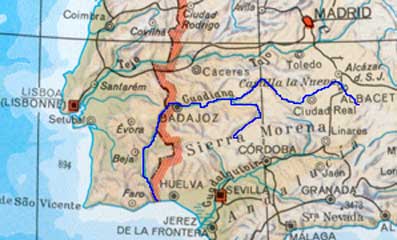
In December, Bruce and I drained the pipes at Lane End and went to Spain to housesit for a month. I found the opportunity on an internet website for housesitters, and after being accepted and exchanging numerous emails, we booked our flights to Faro, Portugal, allowing for a week on either side of the housesit for exploring. We could have flown directly to Spain, but I figured, where's the fun in that? I have always wanted to see something of Portugal, partly because it has a reputation as being a place of sun and ceramics. I'm a sucker for ceramics (a trait I come by honestly via my grandmother, Mamor). With enough cash and space, I would have come back with a sea-freight container of beautiful ceramic objects from both Spain and Portugal. Anyway, we were gone for exactly six weeks.
We flew in to Faro, on the southern coast of Portugal, and found our pension (booked on the internet!) in a fishing village called Olhao, pronounced, more or less, "oolowoo," with a nasal quality to the "ow" part. Portugese is a very strange-sounding language: it looks so much like Spanish, but sounds remarkably like Polish. The final s is like an sh; the o is like an oo; the j is like zsh; the squiggle over the a makes it nasal. It sounds wholly un-Romance languagey. The overall effect is of softness and fuzziness. We stayed in a really nice pension that I had found on the internet back in Lane End, and by luck, was perfect.
The street below Pension Bicuar:

The view from the roof:

A funny meal we had in the pension kitchen (Bruce bravely ate them, but they were a bit strange):

The houses are often sheathed with tiles:

We found a place on the coast for a picnic:

A typical Portugese picnic (with excellent local goat cheese):

Chimney pots and various other earthenware for sale before glazing:

Another view of Olhao from the roof of our pension, looking toward the coast:

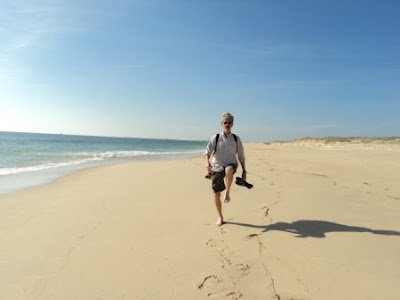
Bruce doing a silly walk on the barrier island near Olhao:
Me paddling in a skirt:

Delicious almonds and raisins:

We spent several days just enjoying the spectacular fish markets, and fresh oranges, and the hams special to the that part of the world, and being in a warm place. Visually, the tiny streets were a delight, of course, and the ever-present tiny handcut cobbles that all the streets are laid with.
Bruce going into the pension door. Note the tiny stones that pave the streets:

An example of some beautiful decay (examples of which we saw in Portugal but never Spain. Spain was very shipshape):

One thing I noticed right away was the lack of noise. The Portugese don't seem to know about Musak, or just don't like it; whatever the case, stores and restaurants are almost eerily quiet. Even a large supermarket was quiet; it was strange to find out what are the natural sounds of people shopping: a clink of a jar coming going into a basket, the sound of little wheels on a floor, footsteps... It was incredibly nice, and created a feeling of calm. At the pension, the only noise outside our window was from human beings. Human beings are pretty noisy, admittedly, but it doesn't effect one the way canned music and traffic noise does; it doesn't jangle your nerves. The morning sounds were of shopkeepers talking across the narrow street to eachother, people jabbering over their morning coffee at the cafes.
Tavira, a sweet town on a river, on our way east from Olhao, heading for the Spanish border: 
Me on above bridge (note the big sign executed in tile):
In Tavira, all of the street signs were like this one: 
A town we discovered with the ruins of a Moorish Castle and a very nice church, so different from English churches:

Some interesting stonework, which was quite rare compared to the prevalence of carving on English Churches: 

After several days in Portugal, we made our way east into Spain, spending a night in Sevilla and a night in Cordoba. Sevilla was enchanting, and we vowed to come back. It has a Seine-like river with charming bridges over it, and a general feeling of classiness and beauty. We wandered about amongst the beautiful buildings, past the bullring, through the Alcazar (Moorish gardens), and generally drinking in the atmosphere of Spanishness and Moorish buildings and the sounds of a Spanish guitar player in the street.
The Guadalquivir River in Sevilla:

Bruce (look closely) on the above bridge:

The bullring, but we couldn't go because it's not the season for bullfights:

At a restaurant in Sevilla:

A tiled chair in the Alcazar (an enormous Moorish castle and garden):

Green lichen on red building -- a typical Spanish colour combination, here shown in its essence:

A tile cat in Sevilla:

A nice square off the huge cathedral in Sevilla:

A beautiful restaurant that wasn't open, unfortunately, but doesn't it look so inviting?

A typical public garden in Sevilla. Note the benches are tiled:

Another example of tile on the outside of a building:

Orange trees line the streets:

On the way to Cordoba we drove through
Carmona. Carmona is just east of Sevilla and was on a plateau, overlooking the plains between Sevilla and Cordoba:

Mostly, the street doors of people's houses are closed, and a street can look uninhabited, but when you saw one open, you got a sense of the pretty courtyards inside, with pretty ironwork, as well:

Here I am enjoying the ubiquitous cafe solo. No matter where you ordered one, a gas station or restaurant, it was always the same and always superb:

Next day we drove to
Cordoba, which was surrounded by some pretty gross urban sprawl, but our pension was in the old part of the city. We stayed at a pension that was a marvelous combination of Spanish and Moorish, and completely typical of Cordoba:


In Cordoba we ate our first meal of tapas. One interesting and delicious dish was simply cut-up oranges, strips of salt cod, and sliced onions, mixed together. Mysteriously, it was absolutely delicious, and I recommend trying it at home. We very nearly went to a Flamenco show, but it didn't begin until 10:30 pm, and we just couldn't manage to stay up that late! Pathetic. In general, it was a surprise just how strong the Moorish influence is. There are the remains of their buildings everywhere, and much of the language as well.
On the way south from Cordoba, heading for the housesit, we passed upteen miles of olive groves, making interesting patterns on the hillsides:

It wasn't until we got to within 2 miles of Rubite that we found ourselves looking down on it and the huge Mediterranean in the distance, our first view. The village looks as old as the hills, and the road down to it looks like a plate of spaghetti. After our white-knuckled drive through the Alpujarras, it was about to get even more exciting. The village streets are about as wide as a car, and the housesit is the last house in the village, down progressively narrowing streets, and getting closer and closer to the "edge" -- literally -- of the village. The house is just one of the traditional dwellings of the village, with white-washed walls and tiled floors. All around are terraced almond and olive trees, flocks of sheep and goats, and the ever-present steep slopes as a backdrop to every scene.
We arrive in Rubite:

Rubite is a tiny village of about fifty houses, some of which are nearly to up-to-date places that a tourist won't feel too challenged by, but it is still very traditional. Running water and electricity only came to the village about twenty years ago; before that, people had to get their water from the village spring. The house we were in would have been the low-rent part of the village, because it is the farthest from the spring.
There is a store, run by Josefina, who is also the postmistress. There are two bakeries, one with a 300-year old oven. There is a doctor's office that is open from 10:30 to 12:30 weekdays. There is a church which hardly anybody goes to except a handful of elderly ladies. There was a school, but the schoolage population has dropped to 7, so now the kids have to go down the hill to Castell de Ferro, a twenty minute drive. It has several bars, but you have to be told they are there because like all commerce in Rubite, there is no sign to indicate a place of business. The only sign that a place is open is that the door is open, no matter the temperature, and the lights are off. I never once saw a light on in the store. People here seem to have a completely different attitude toward light: the windows are small, the lights are almost always off, the doors are almost always at least ajar if not completely open. I come from a culture (climate?) where the sun and light is what we are always trying to maximize; in this culture, the sun is the enemy. How very foreign.
Stores are all closed from 2 to 5, all over Spain, but cafes are open. This takes some adjusting, and I am glad we were there long enough to change our habits, instead of getting it wrong day after day. The first week, we got it wrong a lot, showing up just as a place was closing. Most of our shopping we did in Castell de Ferro, about six miles away, which is right on the Mediterranean, and has lots of shops even though it's a quarter the size of Montpelier; several fish shops, bakeries, many cafes and restaurants, and a very nice pebble beach where I could let the dog off the leash. We had our Christmas dinner at one of its restaurants: octopus, artichokes, jamon. The food in Spain seemed generally pretty good (speaking of restaurants only, of course, as we didn't get to eat anyone's home cooking except our own), though they don't seem to appreciate green vegetables much.
We were in Rubite long enough to make a few friends. I went three afternoons to visit with Montserrat, an elderly lady who chatted to me one day while I was sketching the scenery. She chatted, I heard but understood little, feeling ashamed not to be able to have a simple conversation. The Rubite accent was pretty challenging, no final "s" on anthing, and generally very fuzzy pronunciation.
Then I got it into my head that she might be willing to converse with me in Spanish, so the next time I saw her, I staggeringly asked, and she said yes. In the course of our chats, she gave me a recipe for cooking bluefish, and for making paella. Visits with her were the only time I was inside a Spanish home, oddly. It was simple, with lots of photos of family members, and the tv going all the time. Windows are always with drawn curtains, so not much light gets in.
The principal forms of income in Rubite are sheep and goats, almonds, olives. There seem to be two large flocks, and daily I would see the shepherd heading out over the landscape with the flock and sheepdogs. Most days you could figure out where the flock was by listening for the sound of the sheep bells, a sound of deep antiquity. The sounds of Rubite were nearly devoid of engines of any kind: birds, people talking, sheep bells, the occasional mule hee-haw. In a month there, I never saw or heard a single piece of aircraft; on a blue sky day, not a contrail was even once to be seen. I have never lived in such a quiet place in my life. Such a feeling of peace. It was a lively place, but never noisy.
Down on the coast, the "plasticos" (huge flat-topped greenhouses) seem to be a source of income, though they are intensely unattractive. The only saving grace is that they are impermanent structures, and can be removed if the land use changes.
Sunset over Rubite:

The view from the roof of the Rubite house, looking at the Mediterranean:

The hillsides leading from Rubite down to Castell de Ferro on the coast:

Every day the shepherds would lead their flocks out of the village and into the hills:

The cloud-and-mountain show in Las Alpujarras and Sierra Nevadas:

Near Rubite was as cork forest, which I found fascinating. Cork is harvested ever seven years, I've been told; more frequently, it kills the tree:

Cork up close:

The cork forest:

Bruce and Jen looking out over the Mediterranean. It's very difficult to photograph the sea because the sun was in the same direction. Notice the typical squiggly road:

Weird hills everywhere, covered with almond trees:

A puff-ball shaped grass:

Jen and I at the Castell beach:

Bob the cat on the terrace:

You often see goldfinches in teensy weensy cages like this one, singing away on the street:

The local flock heading up past our house in the morning:

The mist pouring over the hills:

The mist above in another minute was this dense, and in three minutes will have blown completely away. Almond trees in the mist:

Bruce and I having our second aniversary meal:

The view from our table. Note the edge of the roof is held down with stones. This style of roofing was only a few miles from Rubite -- where the roofs are red tile and slanted -- and is peculiar to this valley:

More almond tree geometry. The spots in the foreground are grapes that aren't trained, we were told because of the terrific winds that they can get in the Alpujarras:

The ubiquitous serrano hams (Strangely, we never saw ONE PIG in six weeks. Where are all the pigs being raised??):

On the road from Rubite to Orgiva. I enjoy sun, silence, and clear air:

A typical doorway in Rubite. The fabric is typical Alpujarran fabric, now made of cotton, but undoubtedly originally would have been wool:

A village in the southern slopes of the Sierra Nevadas:

The view out the kitchen doorway. During the month that we were there, we saw the landscape go from deep winter (Dec) to Spring (Jan 10!). The almond trees came into bloom, the temperature moderated, and our neighbors started planting seedlings. It's all so different from Vermont:

Some of the village ladies in Rubite. Not a word of English was spoken, so we were relying on my nascent Spanish for everything:

Three afternoons, I arranged to get "Spanish lessons" from this lovely elderly lady named Montserrat. We staggered along, helped along by Bailey's Irish Cream:

The village with Mediterranean in the distance, and the terrace outside the kitchen:


We had a visit before Christmas from Heidi and Alice. Here's Heidi in Rubite:

A street in Rubite -- barely wide enough for our small car to squeeze through:

Heidi and I on a walk down in the valley below Rubite:

Me staring at the hillside:

Heidi, Alice and I down in Castell de Ferro:

Here we are toasting Sophie's graduation from University. We skyped her at her graduation party, so everybody got to see everybody. Surreal. If you look very carefully, you will see that the white piece of paper says "Congrats Sophie":

We had fun cooking some meals together with the lovely fresh fish, vegetables, and oranges, and the unbelievably inexpensive wine. The cheapest wine that we bought was a little over a dollar and a half a bottle. Mostly we tried to spend a little more than that. It was a surprise to me how good the wine was. We tried "green wine" from Portugal, though, and it was strange and sort of awful.

Walking the dog:

The endlessly fascinating hills around Rubite:

The Sierra Nevadas and the one of the dozen villages clinging to the landscape:

A street in the village:

Me and the Sierras:

Bruce and I on the beach of Castell de Ferro:

Almond trees in bloom:

Bruce and I in
Granada, in the rain:
 Isla Cristina
 fish vendor explaining a very weird kind of shellfish to me (the little bundles):
 Gibraltar
 is a marvelous sight to behold, a giant rock with the Mediterranean and Africa in the background, and huge ships passing by:

The view from Gibraltar:

The view from the road east of Gibraltar, looking at the coast of Africa:
 Tarifa
 beach and many windsurfers:

Spain takes farming very seriously, and wind farms were no exception. I've never seen anything like these acres and acres of turbines, as we worked our way up the west coast:

At the church tower in
Cadiz:

The view of Cadiz from the bell tower. The geometry of the roofs was very interesting to look at:

Geometry of washing:

As soon as there is an opportunity to get sand between my toes, I do:

The beautiful city of Cadiz:

On our way toward Sevilla for the end of our trip, we went through very flat land:

. . .and the
Guadalquivir river, with cows:

. . .and a big boat:

All in all, the trip was completely fascinating to both of us. We were impressed with the seriousness of all farming pursuits, even if it was on a near vertical slope. We were impressed with the wine, with the rugged beauty of the landscape, and the welcoming attitude of the Spanish people. It sounds so guidebooky to say it, but it is really true that people are welcoming.
What does all this travel mean? What is the purpose of living in a Spanish village for a month?
The best answer I can come up with is that there is something intrinsically important and useful about it: on the one hand, being on the outside looking in and being amazed by the differences, and on the other, being on the inside and amazed at how similar we are. It's a thrill to finding out that we are alike, and a thrill to find customs and foods that seem to make us different.
We have lived in Rubite, in Lane End, and Cabot, all small villages that look very different, and yet, the New Year's Eve dance in Rubite was not very different from Fred Ducharme's New Year's Eve party at the Cabot Town Hall, though both rather different from the Lane End Village Hall Quiz Night. In Rubite, the party (which was put on by the chief barkeeper, who is also the mayor) was crammed with all ages, smoking and drinking and dancing to Spanish music, and just about the entire village was there. (As of the New Year, a new Spanish law banning smoking in public buildings went into effect, so everyone was smoking their brains out on the last possible day.)
I think part of the point of traveling is to fall in love, with a place and its people, and I have a wonderful husband for such an adventure, as he is ready to talk to anyone about pretty much anything, even with only a few words at his disposal! More than a month has passed since we left Rubite, but it's atomosphere is still with me, especially the sight in the morning of the great quiet mountain out the window and the goldfinches singing in the valley below.
 For years I have worked with software developers in Europe and India. Three years ago we met in Germany for a planning meeting, and this May I learned that I would be going to Hyderabad, capital of Andhra Pradesh state, in south-central India for training, and to work with a team for a week.