Monday, January 4, 2010

End of Year -- Major Projects

The big event of December was finishing my program, with its End of Year Show.

My projects, as you may remember, were a pair of chairs from Holyroodhouse Palace – the royal residence in Edinburgh, Scotland , and a gilt settee, plus a small project of two gilt footstools. The show was basically the ten master’s candidates’ pieces on display in an area of the library, with an opening event with wine and the ubiquitous mince pies. Two-bit mince pies are the standard hors d’oeuvre here in the month of December.

Before the show we were each assessed on our written logs and our work, a viva voce which involves standing in front of your work and talking about it and explaining the decisions you made along the way. This can be tricky because, as a green student, some of the decisions were not mine but I had to sound as though they were. First there is an internal assessment, with tutors one knows, and the next day is the external assessment, with someone from outside the University. Our external examiner comes from Birmingham Museum. Questions are asked about what chemicals you used and why did you doing things this or that way? It was nerve racking to wait for, but not that bad once you were actually on the spot.

The high point of the show was the appearance of the Senior Conservator of the Royal Collection, saying how pleased he was with the end result. After living with the pieces for so many months it was gratifying to finally get some feedback.
The frames date from about 1740, and the needlepoint from 1915 (a copy of the original 18th c. designs). The chairs are part of a large set, augmenting the original set of 8 chairs made in Edinburgh in 1723 for Henrietta Duchess of Gordon. Her son lived at Holyroodhouse Palace at the latter part of the 18th c, which is how they came to be there. The needlepoint was made during WWI as a project of Queen Mary’s to return the set to its original scheme, since most of the set had been covered in crimson cut velvet by Queen Victoria.

The chairs arrive, along with a Boulle cabinet in really bad shape:

Brass plaques on the back of the chairs:


First step is always Hoovering:

Linen and jute from previous conservation work was removed with wallpaper paste, steam, and scrapers. Old upholstery was removed. The damage was now clear: broken tenons, much material missing from furniture beetle and tack damage, broken ear, corner, and crest rail, loose joints and small bits barely attached. A 19th c. shellac (not available in 18th c.) was on the show wood, obscuring the beauty of the mahogany.

The frames were partially taken apart, joints re-glued, tenons repaired, furniture beetle and tack damage repaired, missing material filled in, missing decorative piece re-carved; legs were stripped of shellac and hot wax was applied. They were then upholstered in the mid-18th century manner. The needlepoint was cleaned, repaired where necessary, and put back on the chairs.

God-awful tenons:
False tenons clamped and ready to be shaped, and new mahogany corner:
Colle de poisson (fish glue) is used because it dries very strong and flexible to allow for wood’s movement, but was not available in the 18th c, when only hide glue was available. Holes are drilled into the tenons, steam injected to hydrate joints, then colle de poisson injected into holes. Requires three days to cure, unlike hide glue that only needs overnight.

Typical repair to tack hole damage, using West Systems epoxy and microlight:


A new filigree bit was carved where the mahogany was broken:


The finish for the legs, after stripping the shellac, was a hot wax that we made up and applied with a brush and a hot air gun, cured, and buffed with shoe brushes. It makes a virulent mess so should be done before any top covers go on.

Nice leg:


Chair upholstery in process, showing the early 18th c. stuffed (but not stitched)edge:


Calico stage complete:


Back textile in need of repair (note now faded the colours are from original yellow):


Backing the crest rail area with linen and couch stitching:


Cleaning the seats with white spirit, very gently:

Reinstalling the top covers:


The finished chairs, next to the restored Boulle cabinet that took Andreas 225 hours to restore:

Total time spent: 115.25 hours


The chairs with their new covers going back in the Royal Collections van:


Brochure from Holyroodhouse showing other members of set:


Much more information is in my written work, if you want to see it.


The other major piece I did was a carved and gilt Louis XVI-style settee, probably made around 1870. This piece has no provenance but is never-the-less a beautifully made piece of furniture, and was a typical 19th c. reproduction in that it was very well made and successful at copying the proportions and aesthetic of 18th c. French furniture.

The condition of the piece was structurally sound, but there was no upholstery and the gilding was both black with dirt and very chipped and generally coming off. The owner wanted it to look “shabby chic” rather than “bling,” so the goal was not to strip all the gesso and gilding and redo it, but to clean it, stabilize the gesso, clay, and gold layers so that it wouldn’t continue to fall off. In other words, it was a conservation job, not a restoration job. However, a bit of ribbon and a leaf tip were broken, so new material was fashioned out of epoxy and microlight, then filed into shape.


Frame stripped, newly webbed and sprung:


Back, first stuffing and stitched edge:

Close-up of the stitched edge. Note the dirt on the gilding:


After upholstering it up to the calico stage I cleaned and repaired the gilding. Cleaning took 37 hours. Repairing the gilding involves applying gesso (rabbit skin glue and whiting) to all the areas where it is missing or degraded, applying clay bole to those areas, in-painting with water colour, toning (colouring with earth pigments and gelatine size to blend in the new work with the old), and a little re-gilding.

Cleaning the gilding involves experi-
mentation with different agents; the idea is to remove the dirt but not the gilding, which is very water soluble.
Frequently gilding and clay is imitated with watercolour, which can even be burnished. New gesso (white) being painted with watercolour:


Areas that would receive more wear were not in-painted but the clay was replaced. Red clay is mixed up and painted onto the areas of gesso and then burnished with a brush:


Finished settee with top cover:

Detail of double welt cord trim:

Total time taken: 140.5 hours

This is a very cursory explanation of what work was involved and I would be very happy to show my reports to anyone…!

Love, Ellie

Sunday, November 29, 2009

Continental Visit

David had put his Cabot fields away for the year and come to France, so how could we not join him for a weekend in early November? We booked late afternoon passage on the EuroStar -- the fast train that goes under the English channel, and were eating mussels and drinking a fair burgundy in Paris by 9 PM! Marjorie lives in La Rochelle, has visited Vermont several times, and joined us as well.

We stayed in a fourth-floor walkup on the back courtyard at Villa Fenelon: a small and blessedly quiet hotel. Marjorie had lived in Paris for years, and was a very patient tourguide -- basically we took detailed street maps in hand and WALKED for two days. We had cool weather, but fair enough for walking the major avenues, seeing the "big" sights. It was too nice to devote daylight to indoor attractions, though we did go see paintings of Renoir in the 20th Century at the Galeries nationales in the Grand Palais on the Champs-Elysées (at 9PM!) Sorry, but neither of us will offer the kind of emotional reaction that Ellie communicated so well after we saw Van Gogh's work close up in Amsterdam last spring. Renoir moved away from his impressionism later in life, and the subjects and techniques he chose were less thrilling to us.


We went to markets and antique bazarres, fortified with strong coffee and cafe delicacies. The exhibition of historic VOGUE covers down the avenue was of great interest to those with backgrounds in haut couture. And did I say that we walked -- a lot?


We took the Paris Metro to Place de la Nation. Near there is the École Boulle, a center for study of European carving and textile techniques. (Maybe we'll be back sometime!) And of course: we shopped; rather, the two clueless men marked time while the two stylish women disappeared into countless shoe bazaars.


It seems as though the markets are open both day and night in Paris. We browsed a nearly endless gauntlet of stalls with fresh fish, fowl, produce and crafts of every description on Saturday morning. And well into the evening and night, the street vendors are there to supply the neighborhood restaurants or tempt the tourist.


The Eiffel Tower
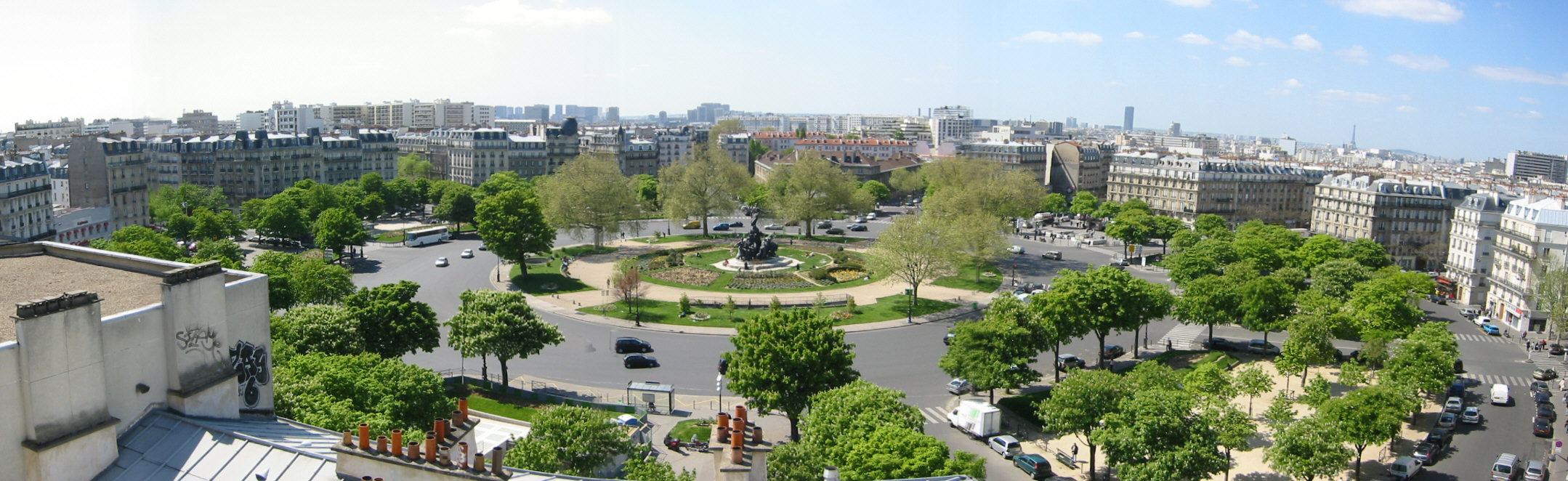
turns 120 years old this fall; David assured us that the view from the Trocadero would be worth it. He was right, and the full moon obliged as well.

Monday, November 16, 2009

Autumn River Sport

When wind and rain lash the cottage for days, and then sunny gentle breezes unexpectedly dominate the Sunday forenoon, a stroll to see our friends the river fowl is in order.

We jump in the car for the 20 minute drive to the carpark at Hambleden End, just a short stroll from Hambleden Lock on the River Thames.
Crossing over the lockgate, we find ourselves on the Thames path, looking for the elusive kingfisher, watching the hordes of Canada geese waddling around the pasture across the water. Summer's baby greebe is gone, but mom (or dad?) is still preening and diving. There are of course lots of gulls, and the occasional pheasant squawk from the hedgerow.


Mom and Dad Swan have come upstream to the lock gate from their usual haunts, probably because the water is high: maybe 1-2 feet above normal, flooding some of their usual gravel shallow. Below the lock he (she?) can stand on a concrete step to preen while she (he?) cruises for touristic breadcrumbs.


But where are the cygnettes? We find them downstream and note for the first time how their juvenile plumage is dropping away, leaving patches of white. They've been as big as their parents for months, and by late winter or spring, they'll look just the same.

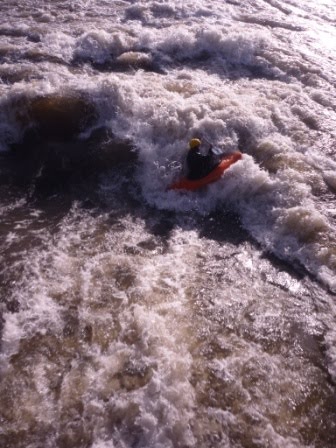
The high water has brought a new kind of creature to The River as well. Just under the wier at Hambleden Lock, where the rains of days past pour in a torrent through the gates, the white water enthusiasts come to hone their skills. Helmets and nose-clips firmly attached, a flick of the wrist makes their little craft jump into the turmoil. They balance artfully on the backwash of the standing wave just below the gate, and are finally swept away, perfecting skills at rolling their white water kyaks.


It seems like it might be a little chilly today. I tried it once, though on a VERY HOT day, on a MUCH warmer river, and a MUCH smaller wave. We watch for awhile, and then head back to Lane End for tea with Ruth.

Saturday, November 14, 2009

Yanks Hike the Moor

The days were shorter and a chill was in the air, but Tom and Susannah Blachly and their son Adam(a.k.a. Hamlet) came to visit Lane End, London, the wilds of Dartmoor, and diverse other countryside attractions. One day off the big bird, they bundled into the car with us for a drive down to Ken & Daf's B&B over the hill from Widecombe-in-the-Moor, Devon, in the middle of Dartmoor Park. Ellie and I had been here in April, and were overtaken by the smell of pina colada: the gorse in bloom! But it was an autumn landscape we found: beautiful, but we were glad to have wool jumpers and a fire to come back to.

We hiked up into the foggy heather and made our way to Grimspound, a huge walled complex in a vale, with the remains of stone huts there since before human memory. What is it? a temple of the Druids, an Iron Age fort, a Roman town, a Phœnician settlement, a medieval tinners camp, a transhumance camp for shepherds, and a pound for stray cattle -- those are just some of the answers.

On a brighter day we determined to go on a goodly high moor hike. We set off on the back roads to an old churchyard, from which we would walk up to Bowerman's Nose, a rock of strange visage offering excellent outlooks. Having seen ponies and sheep grazing in the unfenced moorland expanses, we were amused by the local signage.

From the great lookout we hiked more miles: down through the heather, back up to a Tor over-run with tourists, and down a challenging trail through medieval ruins into a shaded mossy glen. Continuous consultation and comparison of maps didn't prevent some feet from getting wet; all were pleasantly tired by evening.

We had other adventures in Dartmoor; perhaps the most unexpected (and sadly unrecorded) was the finish of a hearty dinner in a country pub on the edge of the village. All were feeling sleepy when under the low sooty beams in front of the fire two fiddles started tuning. Soon joined by guitar, squeezebox and a medieval oboe (yes, we had to ask), the fiddles struck up traditional country dance music. The locals danced and clapped, enjoyed the enthusiasms of the American tourists, and a good many pints were downed by all.


Oh yes. . . we left Dartmoor resolving always to believe the wisdom of local signage.

Wednesday, September 30, 2009

Great Silence

As I return to the blogosphere, I'm aware of the yawning gulf between the long afternoons and ripened grains of my last (August) entry, and the chill winds, lashing rains, and short afternoons of November. Why, you may have asked, have Bruce and Ellie fallen silent?

I can offer two reasons (speaking only for myself.) First, on Labor Day I flew to the US for ten days of work, and a quick visit to Vermont. A long journey brought me to Alabama, where I much enjoy intense, face to face engagements with the colleagues who I see too little. I slowly acclimated to a six-hour time change, American food, driving on the right, and television. I drove a long day through Tennessee hills and hollows, and listened in disbelief to crazed countrymen spitting at each other and warning of "death panels." In Vermont too, though I had warm reunions with friends and family, visited home, and felt the first hard frost, I remained disquieted by My Land, wanting to get home to Lane End. Is America so uncivil as to be ungovernable? Can Obama and hopeful, progressive people make some difference after all? I hope so, from afar, sharing the pragmatic optimism of the American Bard: "When the going gets weird, the weird turn pro."

Also,as we came into Autumn it became more difficult for me to avoid thinking that we were over half-way through the time that we thought we'd spend here. It had gone too fast, the mild spring and long-dayed summer were behind us. Ellie was focused on her last (and seemingly very short) term at University, and we would be facing some decisions about our plans for 2010. We both were completely consumed with playing a Gilbert & Sullivan operetta during the first week of October, and the days had too few hours.

But Autumn has moved nearly into Holiday Time, and the end of her University term is in sight. Despite hearing from you and from me what an evocative writer she is, My Wife is too consumed with her University projects, just now, to share her experiences and thoughts. I hope she will soon. In the meanwhile, Her Majesty has let us know the terms on which she will entertain our application to extend our visas beyond February, and we have plans in Olde England stretching till the end of April, at least. My daughter Juliana was scheduled to come visit just before Christmas, but had to change plans, so our Christmas and Boxing Day will be spend in Gloucester and on the shore in Wales with friends. And we, at least I, am looking forward to evenings by the fire, days that will soon begin to be longer -- we are dreadfully further North, you know, than you are -- and plans to get out and see the countryside. Actually, we've had some great times out and about this fall, and I'll end this silence with another post soon.

Sunday, August 23, 2009

Faithful but Unfortunate

The family motto -- Fiel Pero Desdichado -- is still used by descendants. It was coined by the impoverished cavalry captain Winston Churchill, who paid a huge fine -- £500 was big money in those days -- for backing the losing Royalists in the English Civil War. But he soon (1650) sired the second of nine children John Churchill, who had the good sense to switch to the winning side in the Glorious Revolution of 1688, went on to the Captain-Generalcy of all British forces, and won the Battle of Blenheim (1704). Queen Anne and the grateful nation granted him the Manor of Woodstock, the funds to build Blenheim Palace, and the title Duke of Marlborough.


I decided two Saturdays ago (while Ellie was nursing along her thesis) to take a lovely summer day and see some of the environs. (Not Blenheim itself, as that is a day trip we'll take together.) My first goal was to see the Combe Mill: the original ‘power house’ of the old Blenheim Palace Estate timber mill and workshops.


The Mill has an original 1852 "beam" engine and the even older water wheel, plus a lot of neat museum stuff focusing on old technology. I visited on one of the few days they crank up the old steam power; the place is full of older gentlemen volunteers eager to share their stories of the old days and the old tools. The thing I enjoy most about this is meeting older folks who really have a passion and a history, whether it be for steam engines, clocks or old cars.


Nigel started with a 17th century village clockworks, ended with Big Ben, and told me more about the huge leaps in horology than I ever thought possible.

Old Jack as had his vintage roadster for nearly forty years, and was here for a rally of old time MGs.


Tying all this together (for me, at least, on a glorious summer afternoon) was a five-mile run through the countryside around Blenheim. Park in a country church-yard, jump into running shorts and shoes, jog up the farm lane and out onto the stoney road leading up the ridge, and catch the view across Oxfordshire. Sometimes along the edges of fields, sometimes through the wheat-stalks or forests; but I stop at a stoney house.


Greeted by a pack of curious house dogs and their peg-legged master, I learn that yon hedgerow, which my trail will follow, is the medieval path north from Oxford to Bladon. And this was the path taken by the aforementioned Royalist army in June 1646, retreating from Oxford to Bladon, led by Charles, the king whose career was cut short by a severe neck injury. Local legend has it that in this house (well, the oldest stone portion) the King spent the night, but I will take the trail upon which that elder Churchill doubtless followed his master, for I am to pay my respects to The Great Man.

Sir Winston Churchill was born at Blenheim in 1874, and for all his life frequented Bladon, the town just outside the estate. Many Churchills are buried in the yard of the 12th century church, and so -- after a State Funeral in London in 1965 -- was he.

But I still have two miles back to the car, up lanes, across stoney fields, dodging horse pies and nettles.

"The length of this document defends it well against the risk of its being read." -- Winston Churchill

Thursday, August 6, 2009

Laphroaig

It burns on the way down, but it is one of the great malt whiskys, made on the Isle of Islay, off the west coast of Scotland. (And that's not a typo: it is the way they spell it.) Islay was a little too far on road and on boat to fit into our Scottish vacation with Ellie's daughters Sophie and Heidi, but we did make it to Arran. Just a 40-minute ferry ride from Ardrossan, home of sheep and one of Britain's largest wind farms, but it's wonderfully wild.

Arran is home to Goat Fell, at 874 meters, not quite one of the Munros, but a good six-hour hike nonetheless. (Mountain peaks in Scotland over 3,000 feet are called "Munros" because Sir Hugh Munro in 1891 produced a definitive list of all 284.) We started right at sea level, driving to Brodick Castle, the start of the trail. The castle is over 600 years old, and has some crusty battlements from Robert the Bruce's struggle for Scotland, but was mostly destroyed in fighting in 1455 and later. Conquered and occupied by Roundheads in the seventeenth century, the castle also received a gracious 17th Century makeover for the 10th Duke of Hamilton, whose forebearer received the island and castle as a bauble from his cousin James IV. About 100 years ago Brodick Castle passed into the hands of Mary, Duchess of Montrose (daughter of the 12th Duke of Hamilton) who revitalised the gardens. She was quite a lady, as I hope you will learn soon (from Ellie), as Lady Mary has a direct connection to Ellie's thesis project: two eighteenth century mahogany chairs from Holyrood Palace, the royal residence in Edinburgh. (The name means "Holy Cross:" there's a whole story involving royal princes, enchanted stags, and ruined chapels, but I digress. . . )

Back to Goat Fell: we struck out from the Brodick Castle grounds, spending a half hour or more in farm fields and woodlands. Everyone says vacations in Scotland mean two things: rain and the fierce Highland Biting Midge, Culicoides impunctatus.We kept an eye out for both, but had good luck. We cleared the tree line, constantly removing layers when the sun shone, and re-bundling under the scudding clouds and wind gusts. The trail was periodically steep, and leveled out in an open vale as the vistas across the sea to east and south opened.

Once in the open, the trail was well-tended, with portions that had had great trail work: vitually paving with flat rocks the sections subject to water damage. The trail comes to the base of a ridge, thankfully sheltered partially from the wind, and then begins to climb. As the ground cover thins, you go for long sections hefting yourself from boulder to boulder, up giant steps.

At times it is quite steep and the ridge is narrow: it is easy to feel your fear of making a mis-step or catching a gust of wind that will carry you off your feet and down. Not dangerous or technical, though Goat Fell does carry away hikers every year: mostly in radical shifts of weather.

Still no rain or midges, and we made our way up the final ridge, stopping for breath until we finally saw the penultimate ledge. A couple of young lads bouncing up the trail heedlessly gave Ellie the needed final jolt of certitude to make it.

Everyone had said that the 360 degree view of island, mountains and ocean made the effort worthwhile: they were right. I looked wistfully at the trail leading across to a neighboring peak and down to the shore, but knew that weather was headed our way.

So what about the trip down? Still no midges, and getting down the steep part seemed as easy as taking an elevator. Lower down, I was recounting a tale of having been hit by a cold front and sideways rain/hail in Dartmoor last spring, when what should happen: we were soaked by about ten minutes of hard slanting downpour!

But it was no big deal: the sun came back out before we hit the trees, and we were barely damp by the time we got back to the castle. All of this is quite easy to take when you know that a hot shower, good meal, and a dram of Laphroaig is in the near future.