Monday, November 16, 2009

Autumn River Sport

When wind and rain lash the cottage for days, and then sunny gentle breezes unexpectedly dominate the Sunday forenoon, a stroll to see our friends the river fowl is in order.

We jump in the car for the 20 minute drive to the carpark at Hambleden End, just a short stroll from Hambleden Lock on the River Thames.
Crossing over the lockgate, we find ourselves on the Thames path, looking for the elusive kingfisher, watching the hordes of Canada geese waddling around the pasture across the water. Summer's baby greebe is gone, but mom (or dad?) is still preening and diving. There are of course lots of gulls, and the occasional pheasant squawk from the hedgerow.


Mom and Dad Swan have come upstream to the lock gate from their usual haunts, probably because the water is high: maybe 1-2 feet above normal, flooding some of their usual gravel shallow. Below the lock he (she?) can stand on a concrete step to preen while she (he?) cruises for touristic breadcrumbs.


But where are the cygnettes? We find them downstream and note for the first time how their juvenile plumage is dropping away, leaving patches of white. They've been as big as their parents for months, and by late winter or spring, they'll look just the same.

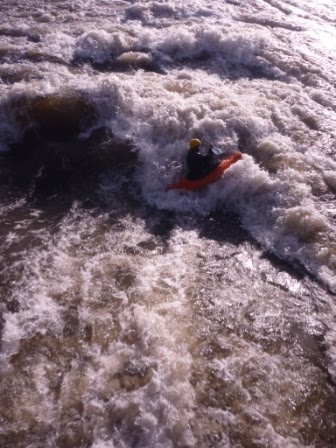
The high water has brought a new kind of creature to The River as well. Just under the wier at Hambleden Lock, where the rains of days past pour in a torrent through the gates, the white water enthusiasts come to hone their skills. Helmets and nose-clips firmly attached, a flick of the wrist makes their little craft jump into the turmoil. They balance artfully on the backwash of the standing wave just below the gate, and are finally swept away, perfecting skills at rolling their white water kyaks.


It seems like it might be a little chilly today. I tried it once, though on a VERY HOT day, on a MUCH warmer river, and a MUCH smaller wave. We watch for awhile, and then head back to Lane End for tea with Ruth.

Saturday, November 14, 2009

Yanks Hike the Moor

The days were shorter and a chill was in the air, but Tom and Susannah Blachly and their son Adam(a.k.a. Hamlet) came to visit Lane End, London, the wilds of Dartmoor, and diverse other countryside attractions. One day off the big bird, they bundled into the car with us for a drive down to Ken & Daf's B&B over the hill from Widecombe-in-the-Moor, Devon, in the middle of Dartmoor Park. Ellie and I had been here in April, and were overtaken by the smell of pina colada: the gorse in bloom! But it was an autumn landscape we found: beautiful, but we were glad to have wool jumpers and a fire to come back to.

We hiked up into the foggy heather and made our way to Grimspound, a huge walled complex in a vale, with the remains of stone huts there since before human memory. What is it? a temple of the Druids, an Iron Age fort, a Roman town, a Phœnician settlement, a medieval tinners camp, a transhumance camp for shepherds, and a pound for stray cattle -- those are just some of the answers.

On a brighter day we determined to go on a goodly high moor hike. We set off on the back roads to an old churchyard, from which we would walk up to Bowerman's Nose, a rock of strange visage offering excellent outlooks. Having seen ponies and sheep grazing in the unfenced moorland expanses, we were amused by the local signage.

From the great lookout we hiked more miles: down through the heather, back up to a Tor over-run with tourists, and down a challenging trail through medieval ruins into a shaded mossy glen. Continuous consultation and comparison of maps didn't prevent some feet from getting wet; all were pleasantly tired by evening.

We had other adventures in Dartmoor; perhaps the most unexpected (and sadly unrecorded) was the finish of a hearty dinner in a country pub on the edge of the village. All were feeling sleepy when under the low sooty beams in front of the fire two fiddles started tuning. Soon joined by guitar, squeezebox and a medieval oboe (yes, we had to ask), the fiddles struck up traditional country dance music. The locals danced and clapped, enjoyed the enthusiasms of the American tourists, and a good many pints were downed by all.


Oh yes. . . we left Dartmoor resolving always to believe the wisdom of local signage.

Wednesday, September 30, 2009

Great Silence

As I return to the blogosphere, I'm aware of the yawning gulf between the long afternoons and ripened grains of my last (August) entry, and the chill winds, lashing rains, and short afternoons of November. Why, you may have asked, have Bruce and Ellie fallen silent?

I can offer two reasons (speaking only for myself.) First, on Labor Day I flew to the US for ten days of work, and a quick visit to Vermont. A long journey brought me to Alabama, where I much enjoy intense, face to face engagements with the colleagues who I see too little. I slowly acclimated to a six-hour time change, American food, driving on the right, and television. I drove a long day through Tennessee hills and hollows, and listened in disbelief to crazed countrymen spitting at each other and warning of "death panels." In Vermont too, though I had warm reunions with friends and family, visited home, and felt the first hard frost, I remained disquieted by My Land, wanting to get home to Lane End. Is America so uncivil as to be ungovernable? Can Obama and hopeful, progressive people make some difference after all? I hope so, from afar, sharing the pragmatic optimism of the American Bard: "When the going gets weird, the weird turn pro."

Also,as we came into Autumn it became more difficult for me to avoid thinking that we were over half-way through the time that we thought we'd spend here. It had gone too fast, the mild spring and long-dayed summer were behind us. Ellie was focused on her last (and seemingly very short) term at University, and we would be facing some decisions about our plans for 2010. We both were completely consumed with playing a Gilbert & Sullivan operetta during the first week of October, and the days had too few hours.

But Autumn has moved nearly into Holiday Time, and the end of her University term is in sight. Despite hearing from you and from me what an evocative writer she is, My Wife is too consumed with her University projects, just now, to share her experiences and thoughts. I hope she will soon. In the meanwhile, Her Majesty has let us know the terms on which she will entertain our application to extend our visas beyond February, and we have plans in Olde England stretching till the end of April, at least. My daughter Juliana was scheduled to come visit just before Christmas, but had to change plans, so our Christmas and Boxing Day will be spend in Gloucester and on the shore in Wales with friends. And we, at least I, am looking forward to evenings by the fire, days that will soon begin to be longer -- we are dreadfully further North, you know, than you are -- and plans to get out and see the countryside. Actually, we've had some great times out and about this fall, and I'll end this silence with another post soon.

Sunday, August 23, 2009

Faithful but Unfortunate

The family motto -- Fiel Pero Desdichado -- is still used by descendants. It was coined by the impoverished cavalry captain Winston Churchill, who paid a huge fine -- £500 was big money in those days -- for backing the losing Royalists in the English Civil War. But he soon (1650) sired the second of nine children John Churchill, who had the good sense to switch to the winning side in the Glorious Revolution of 1688, went on to the Captain-Generalcy of all British forces, and won the Battle of Blenheim (1704). Queen Anne and the grateful nation granted him the Manor of Woodstock, the funds to build Blenheim Palace, and the title Duke of Marlborough.


I decided two Saturdays ago (while Ellie was nursing along her thesis) to take a lovely summer day and see some of the environs. (Not Blenheim itself, as that is a day trip we'll take together.) My first goal was to see the Combe Mill: the original ‘power house’ of the old Blenheim Palace Estate timber mill and workshops.


The Mill has an original 1852 "beam" engine and the even older water wheel, plus a lot of neat museum stuff focusing on old technology. I visited on one of the few days they crank up the old steam power; the place is full of older gentlemen volunteers eager to share their stories of the old days and the old tools. The thing I enjoy most about this is meeting older folks who really have a passion and a history, whether it be for steam engines, clocks or old cars.


Nigel started with a 17th century village clockworks, ended with Big Ben, and told me more about the huge leaps in horology than I ever thought possible.

Old Jack as had his vintage roadster for nearly forty years, and was here for a rally of old time MGs.


Tying all this together (for me, at least, on a glorious summer afternoon) was a five-mile run through the countryside around Blenheim. Park in a country church-yard, jump into running shorts and shoes, jog up the farm lane and out onto the stoney road leading up the ridge, and catch the view across Oxfordshire. Sometimes along the edges of fields, sometimes through the wheat-stalks or forests; but I stop at a stoney house.


Greeted by a pack of curious house dogs and their peg-legged master, I learn that yon hedgerow, which my trail will follow, is the medieval path north from Oxford to Bladon. And this was the path taken by the aforementioned Royalist army in June 1646, retreating from Oxford to Bladon, led by Charles, the king whose career was cut short by a severe neck injury. Local legend has it that in this house (well, the oldest stone portion) the King spent the night, but I will take the trail upon which that elder Churchill doubtless followed his master, for I am to pay my respects to The Great Man.

Sir Winston Churchill was born at Blenheim in 1874, and for all his life frequented Bladon, the town just outside the estate. Many Churchills are buried in the yard of the 12th century church, and so -- after a State Funeral in London in 1965 -- was he.

But I still have two miles back to the car, up lanes, across stoney fields, dodging horse pies and nettles.

"The length of this document defends it well against the risk of its being read." -- Winston Churchill

Thursday, August 6, 2009

Laphroaig

It burns on the way down, but it is one of the great malt whiskys, made on the Isle of Islay, off the west coast of Scotland. (And that's not a typo: it is the way they spell it.) Islay was a little too far on road and on boat to fit into our Scottish vacation with Ellie's daughters Sophie and Heidi, but we did make it to Arran. Just a 40-minute ferry ride from Ardrossan, home of sheep and one of Britain's largest wind farms, but it's wonderfully wild.

Arran is home to Goat Fell, at 874 meters, not quite one of the Munros, but a good six-hour hike nonetheless. (Mountain peaks in Scotland over 3,000 feet are called "Munros" because Sir Hugh Munro in 1891 produced a definitive list of all 284.) We started right at sea level, driving to Brodick Castle, the start of the trail. The castle is over 600 years old, and has some crusty battlements from Robert the Bruce's struggle for Scotland, but was mostly destroyed in fighting in 1455 and later. Conquered and occupied by Roundheads in the seventeenth century, the castle also received a gracious 17th Century makeover for the 10th Duke of Hamilton, whose forebearer received the island and castle as a bauble from his cousin James IV. About 100 years ago Brodick Castle passed into the hands of Mary, Duchess of Montrose (daughter of the 12th Duke of Hamilton) who revitalised the gardens. She was quite a lady, as I hope you will learn soon (from Ellie), as Lady Mary has a direct connection to Ellie's thesis project: two eighteenth century mahogany chairs from Holyrood Palace, the royal residence in Edinburgh. (The name means "Holy Cross:" there's a whole story involving royal princes, enchanted stags, and ruined chapels, but I digress. . . )

Back to Goat Fell: we struck out from the Brodick Castle grounds, spending a half hour or more in farm fields and woodlands. Everyone says vacations in Scotland mean two things: rain and the fierce Highland Biting Midge, Culicoides impunctatus.We kept an eye out for both, but had good luck. We cleared the tree line, constantly removing layers when the sun shone, and re-bundling under the scudding clouds and wind gusts. The trail was periodically steep, and leveled out in an open vale as the vistas across the sea to east and south opened.

Once in the open, the trail was well-tended, with portions that had had great trail work: vitually paving with flat rocks the sections subject to water damage. The trail comes to the base of a ridge, thankfully sheltered partially from the wind, and then begins to climb. As the ground cover thins, you go for long sections hefting yourself from boulder to boulder, up giant steps.

At times it is quite steep and the ridge is narrow: it is easy to feel your fear of making a mis-step or catching a gust of wind that will carry you off your feet and down. Not dangerous or technical, though Goat Fell does carry away hikers every year: mostly in radical shifts of weather.

Still no rain or midges, and we made our way up the final ridge, stopping for breath until we finally saw the penultimate ledge. A couple of young lads bouncing up the trail heedlessly gave Ellie the needed final jolt of certitude to make it.

Everyone had said that the 360 degree view of island, mountains and ocean made the effort worthwhile: they were right. I looked wistfully at the trail leading across to a neighboring peak and down to the shore, but knew that weather was headed our way.

So what about the trip down? Still no midges, and getting down the steep part seemed as easy as taking an elevator. Lower down, I was recounting a tale of having been hit by a cold front and sideways rain/hail in Dartmoor last spring, when what should happen: we were soaked by about ten minutes of hard slanting downpour!

But it was no big deal: the sun came back out before we hit the trees, and we were barely damp by the time we got back to the castle. All of this is quite easy to take when you know that a hot shower, good meal, and a dram of Laphroaig is in the near future.

Sunday, July 19, 2009

Summer Showers

Last Wednesday dawned on Ellie’s resolve to go to London to see some very special books and do research related to her thesis. I decided to be a tourist, and we had plans to meet up at Canary Wharf for outdoor dinner (more on that later) –on the site of London’s historic docklands.

I had found two free lunchtime concerts listed for that day, and resolved to spend the day at St. Paul’s Cathedral, in the heart of London. I walked into the cavernous nave to the sound of about 40 American voices singing “O Happy Day” and swaying in gospel harmony. A group from South Carolina, they arrayed in a semi-circle right under the awesome cathedral dome – some 100+ feet across, nearly 200 feet above us – and gave us tourists some old time religion. Actually, since this is a cathedral space, I found it very gratifying that once an hour a canon comes to the PA system to ask for a few minutes of silence and prayer amid the London hubbub.

I took the full tour of the place, amazed at the treasures, the memorials to famous men, and all the history of the place. The fifth cathedral on the site, it was built in 1677-1708 following the Great Fire of London, by Sir Christopher Wren, and remains much as he has envisioned it. Lord Nelson and the Iron Duke (of Wellington) are buried in the crypt, and there are countless monuments linking glory with death in battle: including one to Captain George Blagdon Westcott (of Devonshire), buried at sea after a glorious victory over the French in 1797, and doubtless related to my forbearers (from neighbouring Somerset).

St. Paul’s is an inspiring architectural monument, and I climbed the 530 steps to the “Golden Gallery,” able to look out over the Thames and the great metropolis before thundershowers chased us down. The Quire (that’s right; not spelled “choir”) features amazing baroque carving Grinling Gibbons, whose decorative arts Ellie has come to know in her studies. The American Memorial Chapel stands behind the High Altar in an area that was bomb-damaged during the Blitz of 1940: it has three stained-glass windows that contain images of the seals of the 48 (wartime) states, and a leather volume listing the 28000 Americans who didn’t come home from Europe.

As dinner time approached Ellie and I conferred by cell phone to assess the unstable weather, as we planned to rendezvous for outdoor supper on a blanket on the (damp) grass. The occasion was the outdoor simulcast from the Royal Opera House of Rossini’s Il barbiere di Siviglia. We had been to a digital simulcast from the Metropolitan Opera (NY) before, and guessed that the sound quality and camera work would be excellent. As silly as anything from Gilbert & Sullivan, we saw excellent acting and a major heartthrob tenor Juan Diego Florez. It rained – HARD – for the first five minutes, but we got through the three hour performance damp but excited, and protected by the ground cloths and inflatable pillows provided free by the sponsors. But the big story was the American mezzo-soprano Joyce DiDonato, who performed flawlessly from a wheelchair, having broken her leg on opening night(!!) Her performance got rave reviews, and she tells the entire story on her blog. Talk about a class act! As the stars came out and the chill took hold, we found our way back to Cousin Nancy’s for the night on the wonderful Underground.

Tuesday, July 7, 2009

Holland Journal, from Ellie -- Part 3

Friday, 19-June
On my last day here, I went back to Amsterdam to take in the Rijksmuseum. It is undergoing renovations, and everybody had told me that it was disappointing because only half the paintings are on exhibit, but when I got there I found that they were exhibiting all of the Old Dutch Masters, so that was good enough for me. I only had two hours, but that was enough to feel completely satiated.
The thing that quickly becomes clear is that the likes of Vermeer and Rembrandt did not come out of the blue. Exquisite technical abilities were all around them. I got introduced to some wonderful portrait painters, namely Johannes Verspronck, whose portraits remind me of Richard Avedon photo portraits--they seem completely modern in sensibility. Yet they were painted in the 1650's. The background is like a photostudio backdrop, like the ones for school pictures, and the people are painted so meticulously that it looks like a color photo. Extraordinary.
Then I saw Rembrandts, some that I would never have known were Rembrandts. I think of his style being a bit loose and fuzzy, which I've never been that thrilled with, but here I saw huge, crisply painted portraits, with the characteristic glow of Rembrandt. "The Night Watch" is an enormous painting, about 18 ft wide by 12 ft tall; HUGE. It is a group portrait of Burghers, each of whom had to contribute money to be included in the painting, so only rich men are in it. One of them was so pleased with the painting that he had a very small copy made for himself, also exhibited, from which you can see that the Night Watch used to be wider than it is now, because there are two men on the left side of the copy who are chopped off in the original. Apparently, when the huge painting was done, they wanted to hang it between two doorways, so ...snip snip!!!
I didn't think any museum experience could top the Van Gogh exhibit, but surprise surprise. There are two Vermeer paintings there that had me in tears. I actually had to leave the room until I could collect myself.
The two paintings are "The Little Street" and "The Milkmaid,” each about 18” by 20”. At ten feet away, you think, wow, what beautiful paintings. But when you walk right up to them, something weird happens. At a foot and a half away, The Milkmaid, about which I've never seen anything particularly special, starts to have an electrifying effect, as though it has diamonds embedded in the paint. Something is going on in these two paintings. The effect on me was of being seared as though I were looking at the sun. It is perfect. The stillness of his scene, the moment in time that is absolutely perfect, grabs you by the throat and holds you there until you start to feel shattered, and you can’t figure out why, but you’re compelled to try. The girl's dress is of a blueness that no print can come CLOSE to depicting. Her face is of pure quiet focus, lit from the side window; the plaster wall is so perfectly represented and no amount of staring at the brushstrokes can explain it. Vermeer also mixed sand with the paint, in areas, to create some three-dimensionality, and this makes the paint jump out at you.
In “The Little Street,” again, it is a moment of infinite stillness, even though the women are doing things. On close inspection, you see that the bricks, so tiny, are not painted as bricks at all, just tiny spots, and glimmerings of shape. In both of these paintings, the composition is utter perfection, and that is a beautiful thing to behold. Why are these paintings so moving? Why is perfection so affecting? I've had the same weeping response in the Lacrimosa of Mozart's Requiem. Seeing them was like having the veils removed from your eyes; the clarity and brilliance is almost painful. I felt like running away screaming, "I didn't know!"
Well, now I know. That's all for the Holland Journal, Ellie.

P.S. Any musings on perfection and emotion would be appreciated.